Adaptive thermal comfort is the principle that the temperature people find comfortable rises and falls with recent outdoor weather, provided they can adapt by opening windows or changing clothing. CIBSE TM52 and TM59 use it to assess whether a building is likely to overheat.
Adaptive thermal comfort describes how people respond to the thermal conditions in the buildings they occupy. Rather than treating comfort as a single ideal temperature, it recognises that occupants are active participants. They open windows, draw blinds, change clothing and adjust how they use a space, and over days and weeks their expectations shift with the outdoor climate.
The practical consequence is that the temperature people regard as comfortable in a naturally ventilated building is higher in warm weather than in cool weather. A room at 26 °C can feel acceptable during a warm spell in July yet uncomfortably warm on a mild day in April. Comfort standards that ignore this effect tend to overstate overheating in free running buildings and can push designs towards mechanical cooling that is not needed.
The adaptive approach grew out of field studies carried out in occupied buildings from the 1970s onwards, most notably the work of Michael Humphreys and Fergus Nicol in the UK and the later ASHRAE research project led by Richard de Dear and Gail Brager. These studies compared the temperatures people reported as comfortable with the conditions measured around them. They found a consistent link between comfortable indoor temperature and the outdoor temperature people had recently experienced, which laboratory based models did not predict.
Researchers group the explanation for this pattern under the following headings.
The fourth point is the most important for designers. A building that gives occupants little control removes the adaptive opportunities on which the model depends, and occupants will be less tolerant of warm conditions as a result.
The traditional heat balance approach, developed by P. O. Fanger and set out in ISO 7730, predicts comfort through the predicted mean vote (PMV) and predicted percentage dissatisfied (PPD). It combines air temperature, mean radiant temperature, air speed, humidity, clothing and metabolic rate into a single comfort index. The method is well suited to air conditioned spaces with stable conditions. In naturally ventilated buildings, however, field evidence shows that PMV tends to overpredict warm discomfort, which is the gap the adaptive model was developed to address.
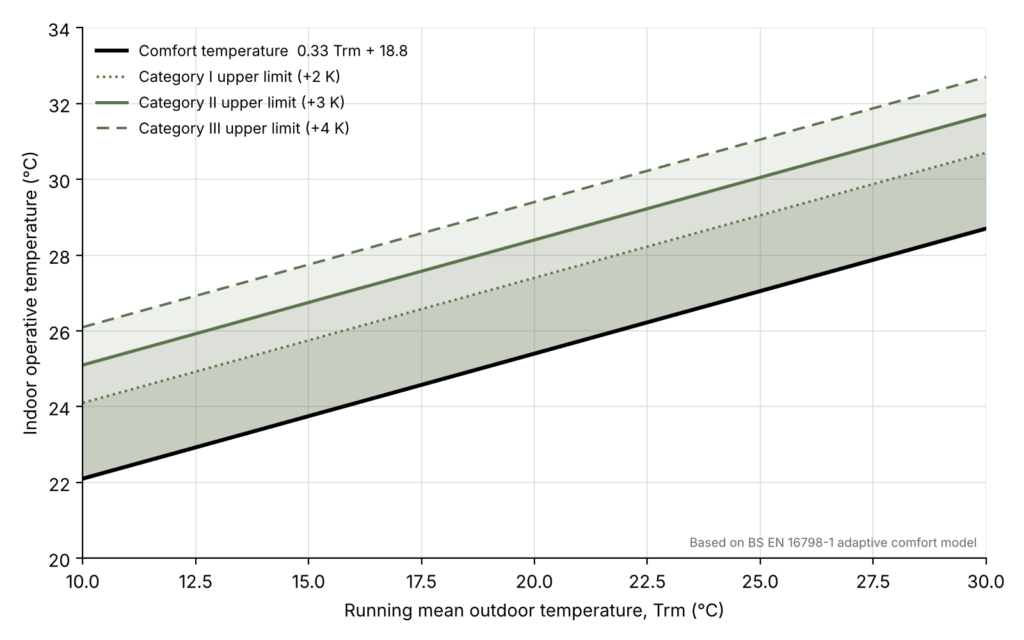
The adaptive comfort model used in the UK and Europe is set out in BS EN 16798-1, which replaced BS EN 15251. It defines the comfort temperature as a straight line function of the running mean outdoor temperature:
Tcomf = 0.33 Trm + 18.8
where Tcomf is the comfort operative temperature in °C and Trm is the running mean outdoor temperature in °C. The relationship is normally applied where the running mean lies between 10 °C and 30 °C, for sedentary occupants who are free to adapt their clothing in spaces with openable windows and no mechanical cooling in operation.
The running mean is an exponentially weighted average of daily mean outdoor temperatures, so recent days count for more than earlier ones. With the weighting factor of 0.8 used in CIBSE TM52, today's running mean equals 0.2 times yesterday's daily mean outdoor temperature plus 0.8 times yesterday's running mean.
Where a continuous record is not available, it can be approximated from the previous seven daily means:
Trm = (T1 + 0.8 T2 + 0.6 T3 + 0.5 T4 + 0.4 T5 + 0.3 T6 + 0.2 T7) ÷ 3.8
where T1 is yesterday's daily mean outdoor temperature, T2 the day before, and so on.
The model sets acceptable limits around the comfort temperature according to the level of expectation of the occupants.
| Category | Typical Application | Upper Limit |
|---|---|---|
| I | High expectation, recommended for spaces occupied by very sensitive or fragile people | Tcomf + 2 K |
| II | Normal expectation, used for new buildings and major refurbishments | Tcomf + 3 K |
| III | Moderate expectation, may be used for existing buildings | Tcomf + 4 K |
Category II is the usual design basis. At a running mean of 20 °C, for example, the comfort temperature is 25.4 °C and the Category II upper limit is 28.4 °C.
CIBSE TM52, The limits of thermal comfort: avoiding overheating in European buildings, applies the adaptive model to free running non-domestic buildings. Dynamic simulation predicts the hourly operative temperature in each occupied space between May and September, and the result is compared with the Category II upper limit (Tmax). A room is classed as overheating if it fails two or more of the following criteria.
| Criterion | Requirement |
|---|---|
| Hours of exceedance | Hours in which the operative temperature exceeds Tmax by 1 K or more must not exceed 3% of occupied hours |
| Daily weighted exceedance | The weighted exceedance, which accounts for both the severity and duration of overheating, must not exceed 6 in any one day |
| Upper limit temperature | The operative temperature must never exceed Tmax by 4 K or more |
The same principles underpin the overheating criteria in Building Bulletin 101 for schools, and TM52 is widely referenced in BREEAM thermal comfort assessments.
CIBSE TM59 sets out the design stage methodology for dwellings and is referenced by Approved Document O (Part O) of the Building Regulations in England. In the 2017 edition, naturally ventilated homes are assessed against the adaptive TM52 hours of exceedance criterion for living rooms, kitchens and bedrooms, with an additional fixed overnight limit for bedrooms. Homes that rely mainly on mechanical ventilation are assessed against a fixed temperature threshold instead.
CIBSE published TM59:2026 in July 2026. The main changes include:
CIBSE has confirmed that TM59 (2017) remains the version required for Part O compliance, while recommending the 2026 edition as industry best practice.
[Pull quote block] Understanding adaptive comfort is essential to predicting overheating accurately. It allows designers to solve the problem with facade design, shading and ventilation before resorting to mechanical cooling.
Because the adaptive model rewards occupant control, the most effective responses to overheating risk are usually passive. They reduce heat gains and make the most of the cooling that air movement and ventilation can provide:
Testing these measures against future weather is increasingly important. CIBSE's Design Summer Year weather files allow a design to be checked against the 2030s, 2050s and 2080s, so that a building which complies today does not become uncomfortable within its lifetime.
KJ Tait's dynamic simulation modellers assess overheating risk using the adaptive frameworks in CIBSE TM52 and TM59. We work with architectural teams from the earliest design stages to shape facades, shading and ventilation strategies that reduce overheating by passive means, and we test designs against current and future weather data so that they remain comfortable over the life of the building.
Adaptive thermal comfort is an approach to thermal comfort based on how people actually behave and feel in real buildings. It recognises that occupants adjust their clothing, activity and surroundings, and that their expectations shift with the weather they have recently experienced. As a result, the temperature people find comfortable is not fixed but follows the running mean outdoor temperature.
The PMV (predicted mean vote) method, set out in ISO 7730, calculates comfort from a heat balance of the body using air temperature, radiant temperature, air speed, humidity, clothing and activity. It works well in air conditioned spaces with controlled conditions. The adaptive model is derived from field surveys in occupied buildings and is used for free running buildings, where PMV tends to predict more discomfort in warm weather than occupants report.
It is an exponentially weighted average of recent daily mean outdoor temperatures, giving more weight to the most recent days. Using the weighting factor of 0.8 adopted in CIBSE TM52, today's running mean equals 0.2 times yesterday's daily mean outdoor temperature plus 0.8 times yesterday's running mean.
Not while mechanical cooling is running. The adaptive model applies to buildings, or periods, in which occupants can open windows and adjust their clothing and no mechanical cooling is operating. Mixed mode buildings can be assessed adaptively during their free running periods, while fully air conditioned spaces are normally assessed against fixed limits or the PMV method.
In building design the term is usually used for low energy measures that work with the adaptive comfort principle rather than replacing it, such as openable windows, night ventilation, external shading and ceiling fans. Increased air movement allows occupants to remain comfortable at higher temperatures, and the 2026 edition of CIBSE TM59 formally credits ceiling fans in overheating assessments.
Yes. CIBSE published TM59:2026 in July 2026. It introduces a three stage assessment process, a new bedroom criterion based on mean overnight temperatures and a requirement to test all dwellings under unconstrained conditions with 2050s weather data. CIBSE has confirmed that TM59 (2017) is still the version required for Part O compliance, while recommending the 2026 edition as best practice.