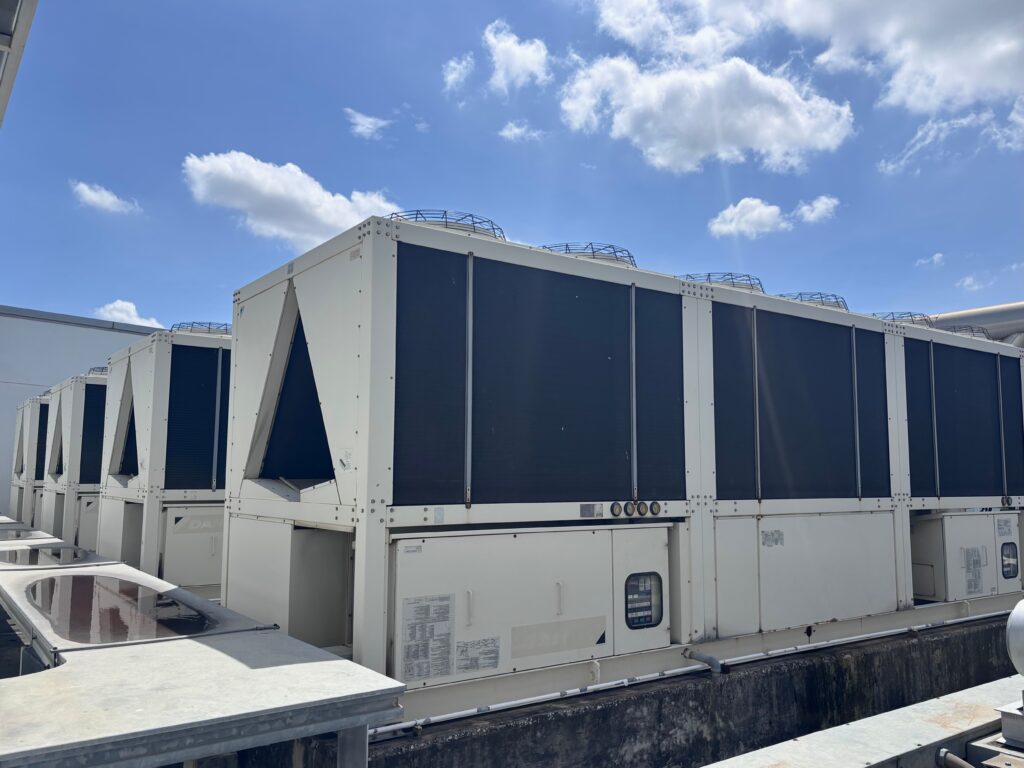
A TM44 air conditioning inspection is a statutory energy assessment of a commercial building's air conditioning system. It is a legal requirement for buildings with systems over 12kW in England, Wales and Scotland. It is carried out by an accredited air conditioning inspector and follows the methodology set out in CIBSE Technical Memorandum 44.
The inspection identifies how efficiently the system is operating, where energy is being wasted and what practical improvements can reduce running costs and carbon emissions. It also confirms whether the building is meeting its legal obligations under the Energy Performance of Buildings Regulations.
A TM44 inspection is not a service visit, maintenance check or F Gas leak test. It is an independent assessment that produces a formal report and, in England and Wales, a certificate lodged on the national register. In Scotland, the report is retained by the building owner.
KJ Tait provides TM44 inspections for commercial buildings across the UK, delivered by chartered building services engineers and accredited assessors.
You need a TM44 inspection if your building has air conditioning with a combined effective rated cooling output of more than 12kW. The threshold applies across all systems within the building, not to each individual unit.
For example, a small office with four wall mounted split units rated at 3.5kW each has a combined output of 14kW and falls within scope. Many small commercial buildings underestimate this and unknowingly miss the requirement.
If you are unsure whether your building is in scope, KJ Tait can review your air conditioning equipment, cooling capacities and control arrangement to confirm your obligations before arranging an inspection.
The person who controls the operation of the air conditioning system is responsible for ensuring the inspection takes place. This is normally the building owner, landlord, managing agent or occupier, depending on the lease and operational arrangement.
Where multiple tenants share a building, responsibility may sit with the landlord or facilities provider. KJ Tait can help clarify responsibility where this is unclear.
In England and Wales, qualifying air conditioning systems must be inspected at least every five years.
In Scotland, the inspection report sets the next inspection timescale, typically between three and five years depending on the condition and efficiency of the plant.
In Northern Ireland, separate regulations apply with broadly equivalent requirements.
KJ Tait can review previous inspection reports and confirm when the next inspection is due.
Failure to hold or produce a valid TM44 air conditioning inspection report can result in enforcement action by Trading Standards in England and Wales.
Current penalties in England and Wales are:
Penalties can accumulate up to £5,000 per building. The UK Government has consulted on increasing the £300 fixed penalty to £800 per building as part of wider reforms to the Energy Performance of Buildings regime.
In Scotland, enforcement is taken under the Building (Scotland) Act 2003 and may include enforcement notices for non compliance.
The financial penalty is often the smallest risk. Missing TM44 documentation can also delay property sales, lease renewals, refinancing, ESG reporting and wider compliance reviews.
A TM44 inspection is a structured review of the air conditioning system, how it is controlled and how it is operated. KJ Tait carries out the inspection in line with CIBSE TM44, focusing on the elements that drive real world energy use and compliance risk.
We assess the condition, age, rated capacity and efficiency of the installed cooling plant. We review whether the system is suitable for the building's current use and identify opportunities for performance improvement.
We review refrigerant type, available F Gas records and evidence that the system is being managed in line with current refrigerant regulations.
We assess air movement, ventilation interfaces and air distribution to identify where comfort and energy efficiency can be improved.
We review time schedules, set points, zoning, simultaneous heating and cooling, BMS strategy and local controls. This is often where the largest energy savings are identified.
We assess maintenance documentation, servicing approach and operational evidence to confirm the system is being managed appropriately.
We assess whether installed cooling capacity is appropriate for the current building use, occupancy and load profile. Oversizing is a common cause of avoidable energy use.
We provide practical, prioritised recommendations to reduce energy consumption, lower running costs and improve building performance.
After the inspection, you receive a formal TM44 inspection report covering:
We also provide guidance on how to act on the recommendations, including links to related KJ Tait services where useful.
KJ Tait is a chartered building services engineering consultancy. Our TM44 inspections are carried out by accredited assessors who are also practising engineers. This means our findings are grounded in how buildings and systems actually operate.
Our assessors understand mechanical systems, controls, ventilation and maintenance. This produces a report that is genuinely useful, not just a compliance document.
We deliver TM44 inspections across England, Wales, Scotland and Northern Ireland for individual buildings, single occupier sites and multi site portfolios.
Our recommendations are designed for building owners, facilities teams and asset managers who need clear next steps, not generic statements.
TM44 inspections often link to commercial EPC strategy, energy auditing, MEES compliance, net zero planning and ongoing facilities management. KJ Tait can support the wider strategy where required.
A TM44 inspection rarely sits in isolation. It often supports wider energy and compliance work, including:
TM44 stands for Technical Memorandum 44. It is the CIBSE guidance that sets out the methodology used for statutory air conditioning inspections in the UK.
The 12kW threshold refers to the combined effective rated cooling output of all air conditioning systems within the building. It is not a per unit limit, which is why many smaller commercial buildings unknowingly fall within scope.
In England and Wales, every five years. In Scotland, every three to five years depending on system condition. In Northern Ireland, broadly equivalent rules apply.
No. A service visit checks and maintains equipment. A TM44 inspection is an independent statutory energy assessment that reviews efficiency, control, sizing, maintenance information and improvement opportunities.
Yes in England and Wales. Reports are lodged on the national register and must be made available within seven days of a request. Scotland follows separate reporting arrangements and the report is retained by the building owner or responsible person.
The person who controls the operation of the air conditioning system, typically the building owner, landlord, managing agent or operational tenant, depending on the lease.
Yes. We can review your air conditioning equipment, rated cooling capacities and control arrangement to confirm whether a TM44 inspection is required.
Yes. KJ Tait supports single buildings, multi site portfolios and staged compliance reviews across the UK.
Yes, in most cases. Our inspections regularly identify opportunities to reduce cooling energy through control improvements, schedule changes, set point adjustments and operational changes that require little or no capital cost.
Speak to KJ Tait to confirm whether your building is in scope, arrange a TM44 inspection or review air conditioning compliance across a property portfolio.