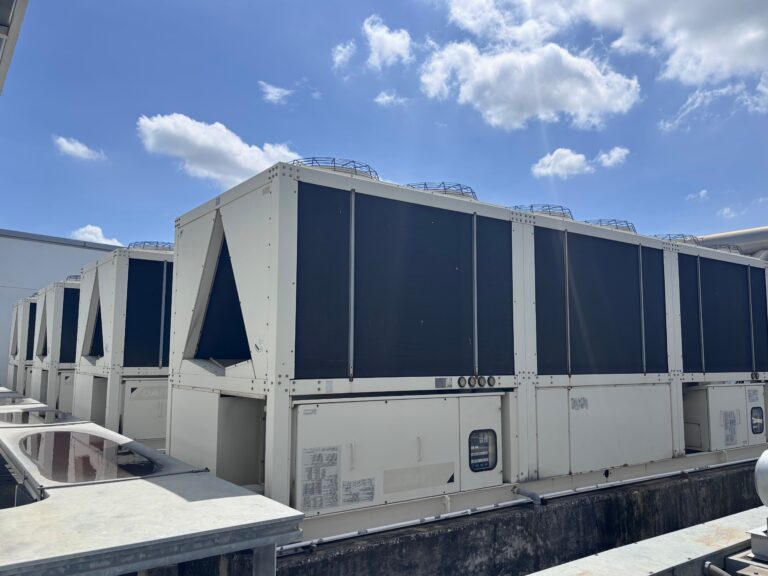
Determine whether your commercial building requires a TM44 air conditioning inspection. Learn how the 12kW threshold works, who is responsible for compliance and what steps you need to take to meet your legal obligations.
If the air conditioning systems under your control have a combined effective rated output of more than 12kW, you normally need a TM44 air conditioning inspection. The threshold applies to the combined cooling capacity, so several small units can bring a building within scope even when no individual unit exceeds 12kW.
Air conditioning inspections are a legal requirement under the Energy Performance of Buildings (England and Wales) Regulations 2012. The person who controls the operation of the system must arrange an inspection by an accredited air conditioning energy assessor at intervals not exceeding five years.
This guide explains how to determine whether your commercial building requires a TM44 inspection, who is responsible and what information you should check.
Your building is likely to require a TM44 inspection when all the following apply:
The regulations apply to air conditioning systems, not simply to large buildings. A small office, shop, clinic or restaurant can therefore require an inspection if several smaller cooling units collectively exceed the threshold.
For TM44 compliance, the relevant figure is the system's effective rated output. This is the maximum cooling output specified and guaranteed by the manufacturer for continuous operation under the stated efficiency conditions.
Where one person controls the temperature of several individual air conditioning units in a building, those units are treated as components of a single air conditioning system. Their rated outputs must therefore be considered together.
Result: TM44 inspection required.
This aggregation rule is one of the most common causes of accidental non-compliance. Property managers may review each unit separately and conclude that none exceeds 12kW, without calculating the combined capacity under their control.
The regulatory wording is more than 12kW. A system rated at exactly 12kW does not cross the threshold, while a combined output above 12kW does.
The definition covers systems that control or lower air temperature. It can also include systems that combine cooling with ventilation, humidity control or air cleanliness.
Systems commonly encountered during commercial TM44 reviews include:
Dedicated process refrigeration requires careful consideration. Government guidance is primarily intended to cover refrigeration used to provide cooling for building occupants, although the regulations do not contain a blanket exemption limiting inspections only to comfort cooling. A competent assessor should review unusual or specialist installations individually.
The requirement depends on the air conditioning system rather than the building's use, ownership, floor area or EPC rating. Buildings that commonly require TM44 inspections because they frequently contain air conditioning systems exceeding 12kW include:
A modest building can exceed 12kW surprisingly quickly. The safest approach is to check the installed plant rather than estimating eligibility from floor area or building type.
Start by preparing an asset list of every air conditioning unit under the control of the relevant owner, occupier or property manager. Record the manufacturer, model number and rated cooling output for each item.
The cooling capacity may be available from:
Do not add heating outputs, electrical input powers or refrigerant quantities. The assessment must use the appropriate rated cooling outputs. Model numbers can sometimes contain capacity indicators, but they should be checked against reliable manufacturer information rather than treated as conclusive evidence.
Incomplete records do not demonstrate that a building is outside the regulations. An initial compliance review can use photographs of equipment labels, floor plans, maintenance schedules and F-Gas information to identify the installed systems and establish whether the 12kW threshold is exceeded.
The responsibility sits with the person who controls the technical operation of the air conditioning system. This means more than having permission to adjust a room thermostat.
Depending on the ownership, lease and management arrangements, the responsible person may be:
Appointing a maintenance contractor does not automatically remove the owner's or occupier's duty. Government guidance states that a landlord or building occupier may retain a parallel duty to ensure the system has been inspected.
For multi-let properties, responsibility may differ between landlord-controlled central plant and tenant-installed systems. The lease, equipment ownership and actual technical control should be reviewed together.
Qualifying air conditioning systems must be inspected at intervals of no more than five years. The due date should be taken from the previous valid inspection report or, for a newly installed qualifying system, the date on which it was first put into service.
If responsibility for a system transfers and the new responsible person is not given the existing inspection report, the regulations require an inspection within three months of taking control.
The inspection must be carried out by an air conditioning energy assessor who is a current member of a government-approved accreditation scheme.
In England and Wales, a valid air conditioning inspection report must be produced and lodged on the Energy Performance of Buildings Register by an accredited assessor. The report includes a unique reference number generated through the register.
A routine maintenance visit, F-Gas inspection or refrigerant leak check does not replace a TM44 inspection. These activities serve different purposes and may be required alongside the statutory energy assessment.
The assessor reviews accessible parts of the air conditioning system and considers how efficiently the system is likely to operate. The inspection normally examines:
The resulting report provides findings and recommendations. There is no general legal requirement under the TM44 provisions to implement every recommendation, but acting on suitable measures can reduce energy consumption, operating costs and carbon emissions.
Good records help the assessor understand the system and can make the inspection more efficient. Useful information includes:
The most recent inspection report must be retained. It should be kept with the building log book, maintenance information or other building energy records and passed to any new person taking control of the system.
Local weights and measures authorities are responsible for enforcing the air conditioning inspection requirements in England and Wales. Enforcement can include requiring documents to be produced and issuing penalty charge notices where the regulations have not been met.
Non-compliance can also create practical problems during:
The greater commercial risk is often poor control of the underlying asset information. If no one can confirm the system capacity, responsible person, previous inspection date or report location, the property owner cannot readily demonstrate compliance.
Facilities and property managers can use the following process to establish the building's position:
For a property portfolio, maintain a central register recording the address, responsible person, cooling capacity, report reference number, inspection date and next due date for each building.
KJ Tait provides TM44 air conditioning inspections and initial compliance reviews for commercial buildings and property portfolios. Our accredited assessors combine the statutory inspection with practical building services engineering knowledge, helping clients understand both their compliance position and the opportunities to improve system operation.
If you are unsure whether a building exceeds 12kW, KJ Tait can review the available asset information, equipment schedules, F-Gas records and plant details before confirming the appropriate next step.
Yes. In England and Wales, air conditioning systems with an effective rated output of more than 12kW must be inspected by an accredited air conditioning energy assessor at intervals not exceeding five years.
Yes. Where one person controls several units in a building, their rated cooling outputs are considered together. Four 3.5kW units have a combined output of 14kW and would exceed the threshold.
The regulations apply to systems with an effective rated output of more than 12kW. A system rated at exactly 12kW does not exceed that threshold.
The interval between inspections must not exceed five years. Check the date shown on the current inspection report rather than relying on an estimated renewal year.
Yes. Local weights and measures authorities enforce the requirements and can issue penalty charge notices. They can also require the responsible person to produce the relevant inspection report.
No. F-Gas checks, maintenance visits and TM44 inspections have different purposes. A qualifying air conditioning system may need all of these activities.
Potentially, yes. The requirement is based on the effective rated output of the installed system, not simply how frequently it operates.
Responsibility depends on who controls the technical operation of the system. This may be the landlord, an occupier under the lease, a tenant that installed its own equipment or, in some circumstances, a contracted facilities management provider.
Check the building log book, operation and maintenance records and the Energy Performance of Buildings Register. If responsibility has transferred to you and no report was provided, the regulations require the system to be inspected within three months of taking control.
Prepare an asset list, verify the rated cooling output of each unit and calculate the combined output under common control. If the records are incomplete or the arrangement is unclear, ask an accredited assessor to undertake an initial compliance review.